

康哲尼龙扎线带的拉力检测
尼龙扎线带(又称尼龙扎带、束线带)是一种广泛应用于电子、电气、包装、建筑等领域的紧固工具,其拉力性能直接关系到使用安全性和可靠性。以下是关于尼龙扎线带拉力检测的详细说明: 一、检测目的 尼龙扎线带拉力检测的核心目的是验证产品是否满足设计标准和使用需求,具体包括: • 确保扎线带在实际应用中能承受预期的拉力载荷,避免因断裂导致固定失效(如线缆脱落、包装松散等)。 • 评估产品的材料质量、生产工艺是否合格,筛选不合格产品。 • 为产品选型、质量控制和标准制定提供数据支持。 二、检测标准 尼龙扎线带的拉力检测需遵循相关国家标准或行业标准,常见标准包括: • 中国国家标准:GB/T 12228-2006《通用型塑料扎带》,明确规定了不同规格扎线带的最小拉力要求、检测方法等。 • 国际标准:如 UL 62275(美国保险商实验室标准)、ISO 14609(国际标准化组织标准)等,针对特定应用场景(如电气设备)的扎线带性能要求。 • 企业内部标准:部分生产企业会根据客户需求制定更严格的内控标准。 三、检测设备 • 拉力试验机:核心设备,需具备精准的力值测量(精度通常为 ±0.5%)和位移控制功能,能记录拉力 - 位移曲线。 • 夹具:根据扎线带形状设计,需保证夹持牢固且不损伤样品(避免因夹持不当导致提前断裂),通常采用平口夹具或专用卡扣夹具。 • 环境控制设备:如需进行高低温环境下的拉力测试,需配备恒温恒湿箱或高低温试验箱。 四、检测样品要求 • 样品数量:通常每组测试至少取 5 个样品,以减少个体差异对结果的影响。 • 样品状态:样品需在标准环境(温度 23℃±2℃,相对湿度 50%±5%)下放置至少 24 小时,消除环境因素对材料性能的影响。 • 样品规格:需明确记录扎线带的宽度、厚度、长度、型号等参数,确保测试的针对性。 五、检测流程 1. 样品准备选取符合规格的扎线带,去除表面污渍或损伤的样品,按要求在标准环境中预处理。 2. 设备调试校准拉力试验机的力值传感器和位移系统,设置测试速度(通常为 50mm/min,具体按标准要求)。 3. 样品夹持将扎线带按实际使用方式扣合(如扣紧至自然状态),两端分别固定在拉力试验机的上下夹具中,确保样品轴线与拉力方向一致,避免歪斜导致的力值偏差。 4. 开始测试启动拉力试验机,施加轴向拉力,记录拉力随位移的变化,直至样品断裂或达到标准规定的最大拉力值。 5. 数据记录记录每个样品的最大拉力值(断裂时的力值)、断裂位置(如卡扣处、带体中间等,用于分析失效原因),以及拉力 - 位移曲线。 6. 结果判定将测试结果与标准要求对比,若所有样品的最大拉力值均不低于标准规定的最小值,则判定为合格;若有样品不合格,可加倍抽样复试,复试仍不合格则整批判定为不合格。 六、常见失效模式及分析 • 卡扣处断裂:可能是卡扣设计不合理、材料强度不足或注塑工艺缺陷(如气泡、飞边)导致。 • 带体中间断裂:可能是带体厚度不均、材料杂质过多或拉伸强度不足。 • 卡扣滑脱:卡扣啮合深度不够或卡扣齿形设计不合理,导致无法承受规定拉力。 七、注意事项 • 测试过程中需避免样品受到侧向力或扭转力,否则会导致测试结果偏低。 • 夹具夹持力度需适中,过松会导致样品打滑,过紧会压伤带体,影响测试准确性。 • 环境温度对尼龙材料性能影响较大,高温可能导致强度下降,低温可能导致脆性增加,需根据实际使用环境选择测试条件。 • 测试后需及时清理设备,检查夹具磨损情况,确保下次测试的准确性。 通过规范的拉力检测,可有效保障尼龙扎线带的使用可靠性,避免因拉力不足引发的安全隐患。在实际应用中,还需结合扎线带的使用环境(如是否接触化学品、紫外线照射等)综合评估其长期性能。 编辑 分享 拉力试验机的精度等级是如何划分的? 检测尼龙扎线带的拉力时,夹具的夹持力度应如何控制? 除了拉力检测,尼龙扎线带还有哪些常见的检测项目?
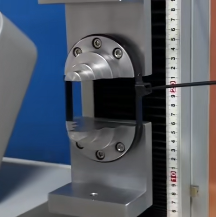
Tensile testing of nylon cable ties Nylon cable ties (also known as nylon ties and cable bundling straps) are fastening tools widely used in fields such as electronics, electrical engineering, packaging, and construction. Their tensile performance is directly related to the safety and reliability of their use. The following is a detailed description of the tensile testing of nylon cable ties: I. Testing purpose The core purpose of the tensile testing of nylon cable ties is to verify whether the products meet the design standards and usage requirements, specifically including: • Ensure that the cable ties can withstand the expected tensile load in practical applications, preventing fixing failures (such as cable detachment and loose packaging) caused by breakage. • Evaluate whether the material quality and production process of the products are qualified, and screen out unqualified products. • Provide data support for product selection, quality control, and standard formulation. II. Testing standards The tensile testing of nylon cable ties needs to follow relevant national or industry standards. Common standards include: • Chinese national standard: GB/T 12228 - 2006 "General - purpose plastic cable ties", which clearly stipulates the minimum tensile requirements and testing methods for cable ties of different specifications. • International standards: Such as UL 62275 (Underwriters Laboratories standard in the United States), ISO 14609 (International Organization for Standardization standard), etc., which specify the performance requirements of cable ties for specific application scenarios (such as electrical equipment). • Internal enterprise standards: Some manufacturing enterprises will formulate stricter internal control standards according to customer requirements. III. Testing equipment • Tensile testing machine: The core equipment, which needs to have accurate force - value measurement (usually with an accuracy of ±0.5%) and displacement control functions, and can record the tensile - displacement curve. • Clamps: Designed according to the shape of the cable ties, they need to ensure firm clamping without damaging the samples (to avoid premature breakage caused by improper clamping). Usually, flat - mouth clamps or special snap - on clamps are used. • Environmental control equipment: If tensile testing under high - and low - temperature environments is required, a constant - temperature and humidity chamber or a high - and low - temperature test chamber is needed. IV. Requirements for test samples • Sample quantity: Usually, at least 5 samples are taken for each group of tests to reduce the influence of individual differences on the results. • Sample state: The samples need to be placed in a standard environment (temperature 23℃±2℃, relative humidity 50%±5%) for at least 24 hours to eliminate the influence of environmental factors on the material performance. • Sample specifications: The width, thickness, length, model and other parameters of the cable ties need to be clearly recorded to ensure the pertinence of the test. V. Testing process 1. Sample preparation: Select cable ties that meet the specifications, remove samples with surface stains or damages, and pre - treat them in the standard environment as required. 2. Equipment debugging: Calibrate the force - value sensor and displacement system of the tensile testing machine, and set the test speed (usually 50mm/min, specifically according to the standard requirements). 3. Sample clamping: Fasten the cable ties in the actual usage mode (such as fastening to the natural state), and fix the two ends of the cable tie in the upper and lower clamps of the tensile testing machine respectively. Ensure that the axis of the sample is consistent with the tensile direction to avoid force - value deviation caused by skewing. 4. Start the test: Start the tensile testing machine, apply an axial tensile force, and record the change of the tensile force with displacement until the sample breaks or reaches the maximum tensile force value specified by the standard. 5. Data recording: Record the maximum tensile force value (the force value at the time of breakage) of each sample, the breakage position (such as at the buckle, in the middle of the strap, etc., for analyzing the failure reasons), and the tensile - displacement curve. 6. Result judgment: Compare the test results with the standard requirements. If the maximum tensile force values of all samples are not lower than the minimum value specified by the standard, the products are judged to be qualified. If there are unqualified samples, double the number of samples for retesting. If the retesting still shows unqualified results, the whole batch is judged to be unqualified. VI. Common failure modes and analysis • Breakage at the buckle: It may be caused by unreasonable buckle design, insufficient material strength, or injection - molding process defects (such as air bubbles and flash). • Breakage in the middle of the strap: It may be due to uneven strap thickness, excessive material impurities, or insufficient tensile strength. • Buckle slippage: Insufficient engagement depth of the buckle or unreasonable buckle tooth profile design, resulting in the inability to withstand the specified tensile force. VII. Precautions • During the testing process, the samples should be prevented from being subjected to lateral or torsional forces, otherwise, the test results will be lower. • The clamping force of the clamps should be moderate. Too loose a clamp will cause the sample to slip, and too tight a clamp will damage the strap, affecting the test accuracy. • The ambient temperature has a great influence on the performance of nylon materials. High temperature may lead to a decrease in strength, and low temperature may increase brittleness. The testing conditions should be selected according to the actual usage environment. • After the test, the equipment should be cleaned in time, and the wear of the clamps should be checked to ensure the accuracy of the next test. Through standardized tensile testing, the reliability of nylon cable ties in use can be effectively guaranteed, and potential safety hazards caused by insufficient tensile force can be avoided. In practical applications, the long - term performance of cable ties also needs to be comprehensively evaluated in combination with their usage environment (such as contact with chemicals, ultraviolet radiation, etc.).
全球服务热线 Global Service Hotline:139-6177-1104
